
Stakeholder Vs. Hegemon: China's fundamental orientation within the international system
On June 2nd, 2026, several top advisors to the International Freedom Alliance (IFA) gathered for a quiet work meeting over the course of several days.
Research, documents and presentations were pre-circulated prior to the work sessions.
These essays, notes, and presentations are posted without attribution for the edification of our readers, until presenters have had the opportunity to review and approve the content in final form.
The content is valuable, coming from individuals with decades of experience on the issues under discussion. Attribution will follow following more careful review from the authors.
For much of the past four decades, Western policymakers pursued a single strategic assumption: that a wealthier, more globally integrated China would eventually become a responsible stakeholder in the international system. Economic liberalization, it was believed, would encourage political moderation, deepen cooperation, and gradually align Beijing with the rules-based international order.
That expectation has become one of the defining strategic miscalculations of the modern era.
In this presentation, delivered during the International Freedom Alliance's June 2026 working sessions, Gerard Willis examines how the Chinese Communist Party's rise has departed fundamentally from those expectations. Rather than viewing China solely through the familiar lenses of trade balances, industrial policy, or military modernization, Willis argues that understanding Beijing's long-term ambitions requires examining the ideological framework that shapes CCP strategy.
His presentation explores China's evolution from a participant in the international system to what he describes as a transformative power seeking to reshape that system in accordance with its own political and strategic objectives.
Central to that discussion is the collapse of what became known as the "Zoellick Thesis." Introduced in 2005, the concept envisioned China becoming a "responsible stakeholder" whose growing prosperity would reinforce rather than challenge the existing international order. Instead, Willis contends that Beijing leveraged access to global markets while preserving a state-directed political economy, using industrial subsidies, technology acquisition, and asymmetric economic policies to strengthen its own position without embracing the reciprocal norms many Western governments expected.
The presentation identifies the rise of Xi Jinping as the decisive turning point. Early hopes that Xi would continue China's gradual technocratic evolution quickly gave way to an unprecedented consolidation of political authority. Under Xi, anti-corruption campaigns became instruments for eliminating rival factions, ideological discipline intensified throughout the Party, and political, military, and economic power became increasingly centralized. Willis argues that this transformation marked a decisive shift away from collective leadership toward a far more ideologically driven model of governance.
Having consolidated authority at home, Beijing increasingly projected its ambitions abroad. Willis examines China's military expansion across the Indo-Pacific, its construction and militarization of artificial islands in the South China Sea, and the global reach of the Belt and Road Initiative. Rather than interpreting these developments as isolated policies, he presents them as components of a coherent long-term strategy designed to expand influence, create strategic dependencies, and reshape the balance of power.
A recurring theme throughout the presentation is that many Western analysts continue to underestimate the role ideology plays in Chinese decision-making. Willis argues that Marxism-Leninism remains a living political doctrine within the CCP, now intertwined with Chinese nationalism, historical grievance, and the Party's determination to secure its own permanence. Ignoring that ideological foundation, he suggests, leads to persistent misunderstandings of Beijing's intentions and strategic behavior.
The presentation concludes by arguing that an effective response requires more than military preparedness or economic resilience. Policymakers must understand the worldview that informs CCP strategy, strengthen democratic institutions and alliances, expose authoritarian abuses where they occur, and articulate a confident alternative rooted in political liberty, national sovereignty, and the rule of law.
We invite the partners and friends of the International Freedom Alliance to engage thoughtfully with this presentation. Understanding China's growing influence requires more than observing its actions; it requires understanding the strategic assumptions and ideological convictions that drive them.
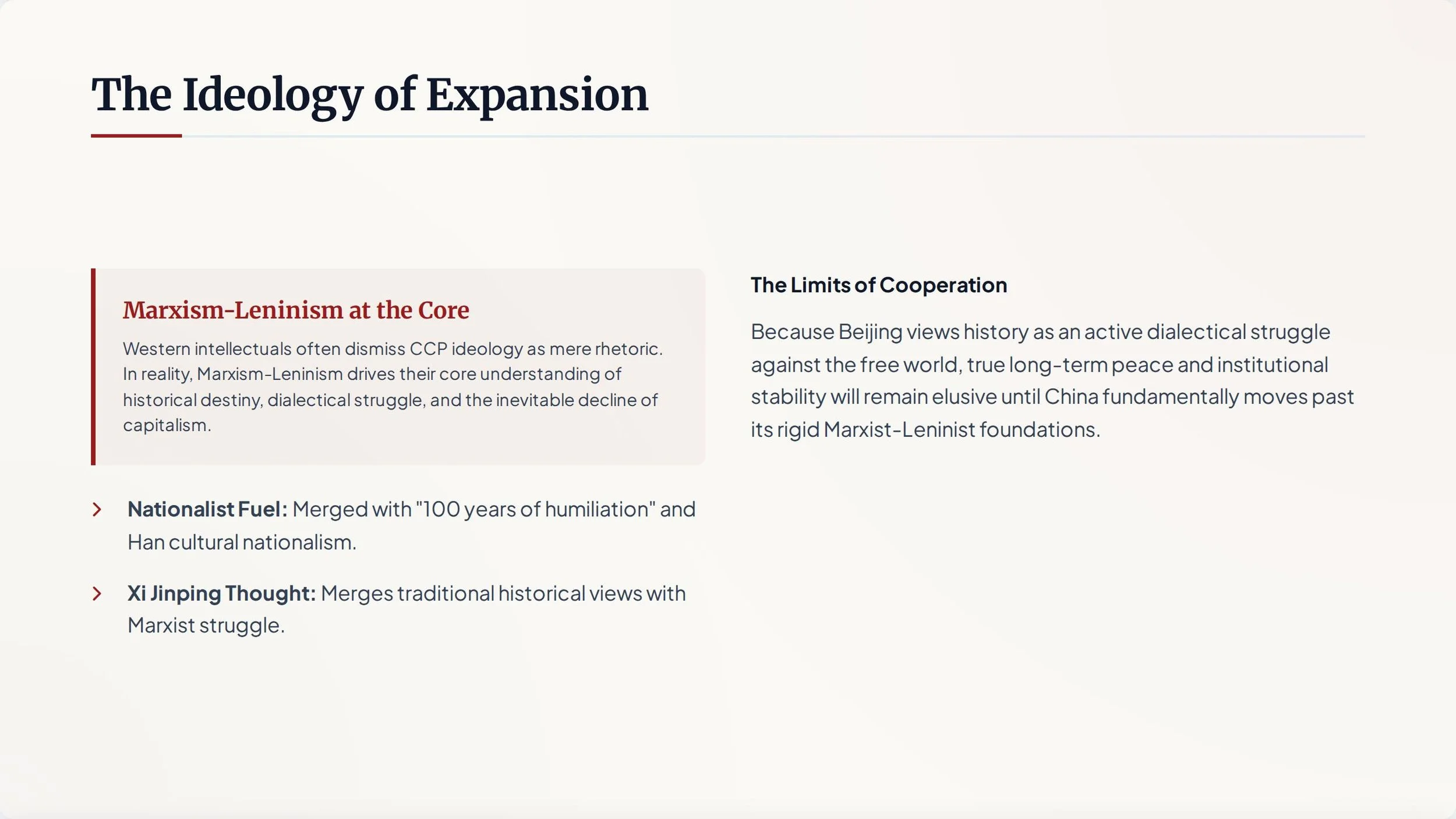
Western intellectuals frequently make the mistake of dismissing CCP ideology as mere rhetoric or historical window dressing. The reality is that Marxism-Leninism is the active, beating heart of China’s grand strategy. Fused with Han cultural nationalism and "100 years of humiliation," this ideology views global relations as an inevitable dialectical struggle against the free world.
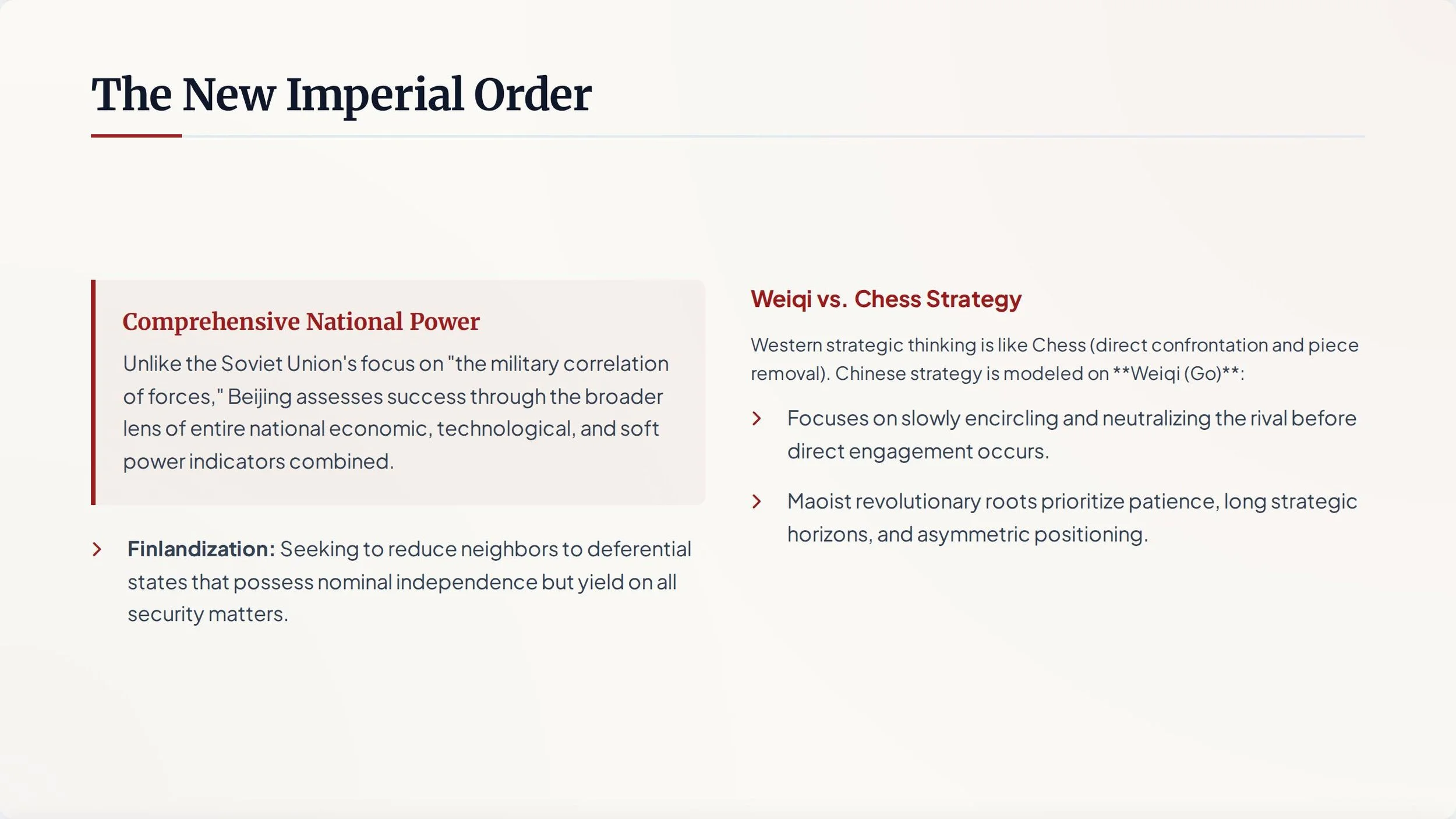
You cannot counter an adversary if you don't understand the game they are playing. There is a deep contrast between traditional Western strategic thinking—which is like Chess (focused on direct confrontation and removing the opponent’s pieces)—with the Chinese strategy modeled on Weiqi (Go). By focusing on long strategic horizons, asymmetric positioning, and the slow encirclement of rivals, Beijing seeks to achieve "Finlandization": forcing nominal independence from its neighbors while completely neutralizing them as security threats.
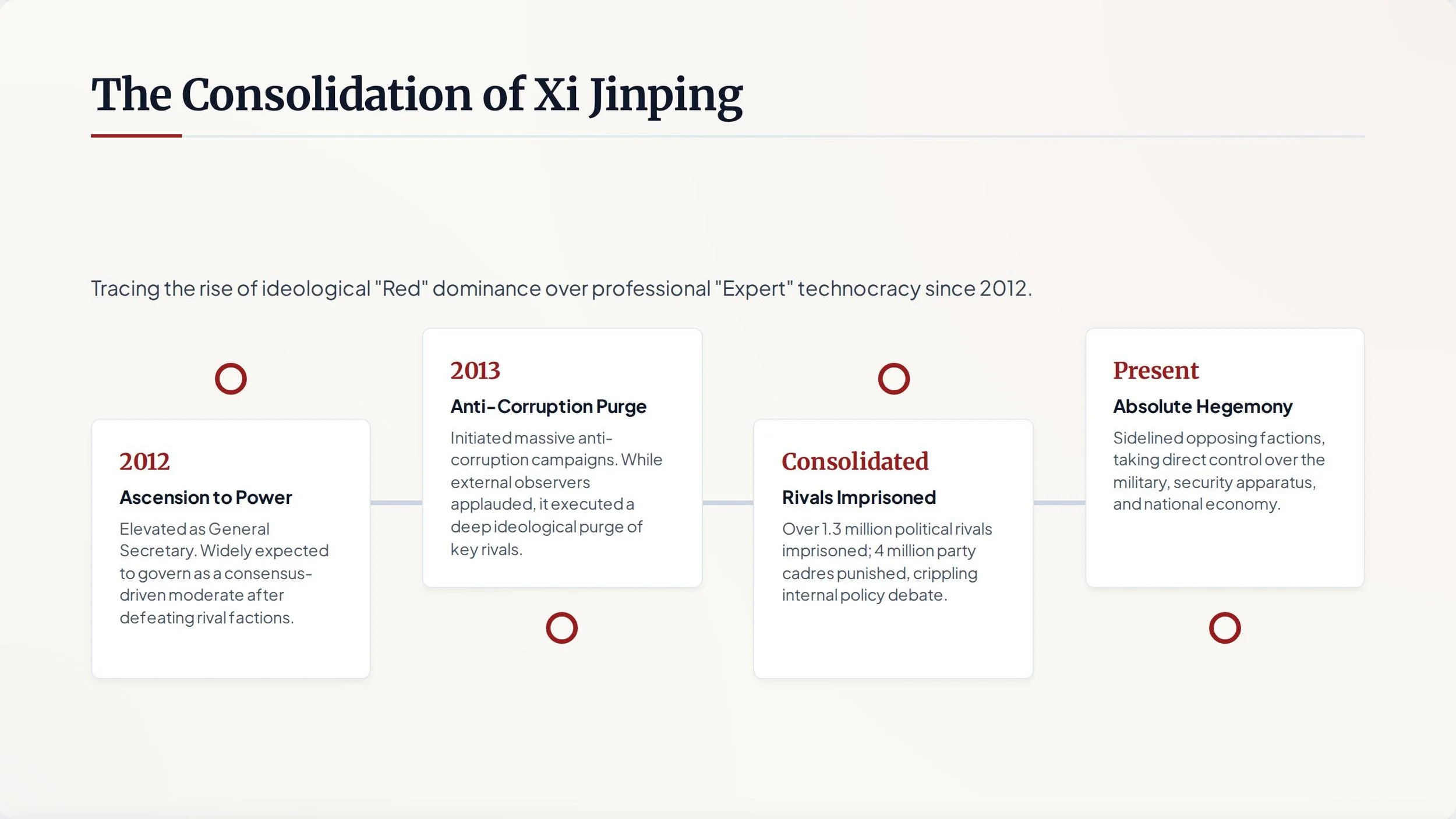
For years, Western analysts operated on the "Great Hope" that global market integration would force the Chinese Communist Party (CCP) to become a moderate, technocratic government. Reality differed. This critical timeline from 2012 to the present demonstrates how Xi Jinping’s highly praised "anti-corruption" campaign was, in reality, a ruthless ideological purge. By sidelining rivals and imprisoning over a million political targets, Xi replaced professional technocrats with ideological hardliners, centralizing absolute control over the military, security apparatus, and national economy.
The IFA would like to extend a thank you to all the scholars, policymakers, and citizens who joined us for this vital discussion. Together, we can build a constructive vision of society grounded in truth, faith, and human dignity.
